
Why SICH Exists
The idea for SICH came from what Ukraine has lived through: strikes on the power grid, blackouts, cyberattacks on mobile operators and entire cities left without communication or internet.
And this is not only Ukraine's story. Around the world, cyberattacks on telecom infrastructure, damaged undersea cables and large-scale blackouts increasingly leave millions of people cut off.
No Mobile Signal
Cell towers have limited range and collapse under overload or damage.
No Internet
Backbone outages and blackouts sever connectivity instantly.
Infrastructure Failure
Disasters, emergencies and power loss disable centralized networks.
Remote Locations
Mountains, seas and wilderness lie far beyond any coverage map.
That is exactly when staying connected matters most. SICH is a mesh network that doesn't depend on any of it: every device talks to the ones nearby and passes messages on.
We develop it as an open project for civilians, volunteers and technical communities, and it keeps improving based on how it performs in real conditions.
Drag to rotate · Ctrl + scroll to zoom
Built for SICH
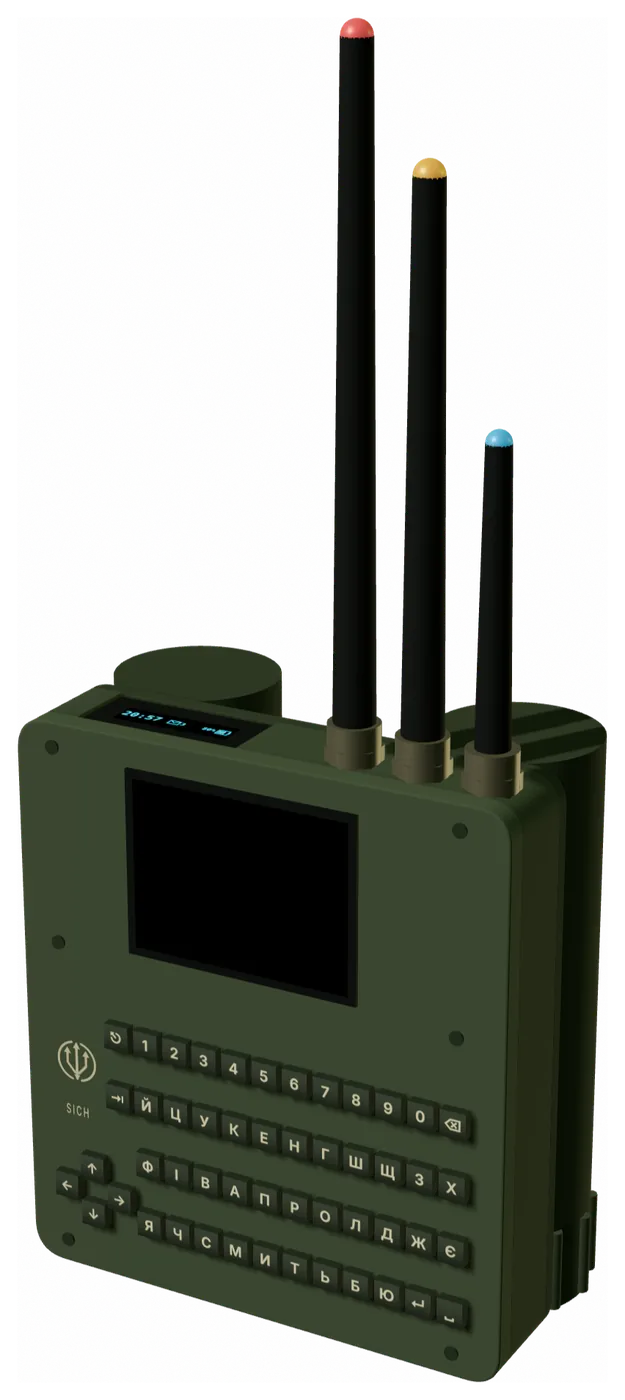
SICH is an open-source mesh network that lets devices exchange messages directly over long-range LoRa radio, with no mobile network and no internet. This is one of the first devices built for it, developed by BFU Electronics as the reference device we use to build and field-test the network. It sends text and short voice messages, and its built-in GPS provides position and accurate time, fully offline. Transmit power goes up to 30 dBm (1 W) and can be set to match local regulations.
Network
SICH mesh
Radio
LoRa 433 / 868 MHz
TX power
Up to 30 dBm (1 W)
Messages
Text + voice
Position
GPS
Internet
Not required
What SICH can do
The core of the network: what already works today and what is on the way.
Text messages
Send messages device to device across the mesh.
01Voice messages
Record a short voice message and send it over LoRa.
02Location sharing
Share your GPS position with other devices.
03Accurate time
GPS keeps time precise with no network at all.
04Multi-hop relay
Every device passes messages on, extending the range.
05Open source
Open firmware, so anyone can build compatible devices.
06Encrypted storage
Chat history and files on the device are encrypted with AES-256.
07Emergency SOS
Send a priority distress signal to every device in range.
08Encryption
End-to-end encryption for private messages.
09Messages travel through the mesh
Every device on the SICH network is a node. A message travels over LoRa radio to the devices nearby, and each one passes it on until it reaches its destination. No mobile operator, no internet provider, no central server.
Who SICH is for
Rescue teams
Coordinate on the ground when cellular networks are down or overloaded.
Volunteers
Stay in touch where infrastructure is damaged.
Families
Keep in touch during blackouts and outages.
Local communities
Build your own network for a street, village or town.
Outdoors
Mountains, forests and sea, far beyond any coverage.
Makers and radio amateurs
Experiment with LoRa, build your own nodes and grow the network around you.
From research to reality
SICH is in active development. Here is where the network stands today.
Research
CompleteRadio, protocol and mesh networking studies.
First device
CompleteReference device and firmware 2.0.
Field testing
UpcomingRange, relaying, voice and SOS in real conditions.
Open release
UpcomingPublic firmware and the web flasher at flasher.sichmesh.org.
Ecosystem
PlannedDevices from other makers running SICH firmware.
Build the network with us
SICH grows with its community. Join the Discord to follow development, test early builds, share feedback and help shape the network.
Development updates first-hand
Early firmware builds for testing
Direct contact with BFU Electronics